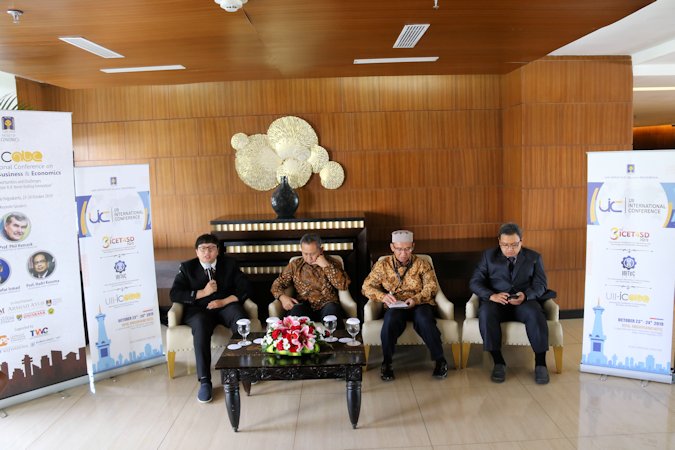
Faculty of Industrial Technology, Universitas Islam Indonesia (UII) in collaboration with Faculty of Economics UII under the facilitation of the Directorate of Research and Community Development (DPPM) UII held UIC (UII International Conference) on Wednesday (23/10) at Royal Ambarukmo Hotel Yogyakarta. This conference, which brought up “Industry 4.0” as a theme, is a joint of 3 different conferences.
The first conference, ICET4SD (International Conference on Engineering Technology for Sustainable Development) is a biennial event inviting 4 keynote speakers: Assoc. Prof. Tomohiko Igasaki from Kumamoto University, Jepang, Prof. Pedro Miguel Ferreira Martins Arezes from University of Minho Portugal, Prof. Wisnu Jatmiko from UII, and Prof. Dato’ Dr. Abu Abdullah from Universiti Teknikal Malaysia Melaka.
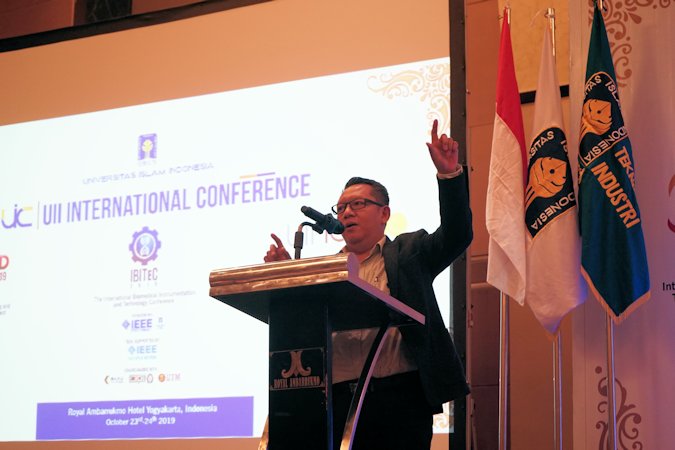
Meanwhile, the second conference, IBITeC (International Biomedical Instrumentation and Technology Conference), was the first time, held by the Department of Electrical Engineering UII. Three keynote speakers delivered lectures in the conference, they are Prof. Udantha Abeyratne from the University of Queensland, Australia, Assoc. Prof. Tomohiko Igasaki from Kumamoto University, Japan, and Assoc. Prof. Norlaili binti Mat Safri from Universiti Teknologi Malaysia.
Last but not least, the 3rd UII-iCabe (UII International Conference on Accounting, Business and Economics) inviting 4 keynote speakers, Prof. Phil Hancock of the University of Western Australia, Prof. Abdul Ghafar Ismail of Kolej Pengajian Islam Johor, Prof. Hadri Kusuma from UII, and Dr. Halim Alamsyah From Loan Guaranty Agency.
The Director of DPPM UII, Dr.Eng. Hendra Setiawan, S.T., M.T expected that UIC would become a pilot project that turns into an international-scale scientific seminar.
“All the accepted scientific papers will be published in reputable and indexed journals like Scopus, Clarivate Analytics, IEEE and national and international journals in partnership with each international seminars,” he added.
There are at least 200 papers accepted from countries like Japan, Portugal, Srilanka, People’s Republic of China, Iraq, Malaysia, Thailand and Indonesia. These papers are then reviewed objectively by reviewers from several countries. The Acceptance Rate of 3rd ICET4SD and 1st IBITeC are 70 % and 60 % respectively. The accepted and presented papers in ICET4SD will be published in IOP Proceeding Series, and some selected papers will be forwarded to be published in selected journals, JMES (Q2) and JAMT (Q3), while the papers in IBITeC will be published online.
ICABE UII ICABE will select 120 best articles to be published in reputable journals. All publication schemes will be checked at main international index database to ensure appropriate visibility of articles/papers internationally.
Curious Conference Topics
The speaker Norlaili from UTM explained about I-Stress apps that he is developing. I-Stress apps is a device that assists people in detecting CVD (Cardiovascular Disease). CVD is a heart-related and blood-vessels-related disease.
“People who suffers from CVD must be quickly treated in the hospital. This app can detect and recommend us when we have to go to the hospital without waiting for emergency,” he explained.
The way it works is by inputting user’s data such as weight, age, sex, and heart rate, that requires GPS, stopwatch and photoplethysmorgram smartphones to count pulse rate. Afterwards, the output will display whether we are in healthy condition, or the app will recommend us to consult a doctor or to obliged us to see a doctor.
Meanwhile, other speaker Prof. Hadri Kusuma explained the function of IT Governance in assisting corporate leaders in their responsibility especially in ensuring that the goals of IT is in line with their business, added value and can count risk and performances.
On the other side of the conference, Abu Abdullah said that there are a few trends in the manufacturing sector, including automated manufacturing system, computer integrated manufacturing, agile manufacturing, E-Manufacturing, digital manufacturing, Intelligent manufacturing and smart manufacturing. He also pointed out that there are several qualifications and essential capability to acquire in this era.
The most important knowledge is about basic ICT (basic information about technology, the skill to interact with computers and robots), capability to work and process data (the skill to process and analyse data and knowing basic statistics), understanding technicalities (possessing a profound understanding in manufacturing activities and tech-savviness) and the last one is to have good personal skills such as decision making.(DRD/ESP)
UII the Best Private University in Community Development Performance
Universitas Islam Indonesia (UII) successfully ranked first among private universities in Indonesia based on the result of Community Development Performance Ranking of Higher Education Institution 2016 – 2018. The assessment result of community development performance is attached in the Decision Letter of Directorate General of Research and Development Corroboration number 29/E/KPT/2019 dated 27 September 2019 aout Ranking of Higher Education Institutions based on Community Development Performance 2016-2018. UII earned the predicate as Excellent in community development sector in the ranking.
Read more
Students of UII and UTP Malaysia Committed to Continue Social Project
A series of collaboration entitled Joint Activities & Student Collaboration Program of Universitas Islam Indonesia (UII) and Universiti Teknologi Petronas (UTP) Malaysia was officially closed this Friday. (1/11). Nevertheless, both parties are committed to run the social project continuously in the coming years. In the closing ceremony, a team of students from UTP, UII and Airlangga University (UNAIR) presented their prototypes or basic model of a program, idea or effective technology that has potential to be marketed.
Read more
UII-UTP Malaysia Cooperation Resulted in Social Project
Universitas Islam Indonesia (UII) consistently promotes the expansion of education access, collaboration and also student initiatives and innovation. One of its manifestations is its cooperation with universities from other countries, such as Universiti Teknologi Petronas (UTP) Malaysia. The cooperation between UII and UTP is implemented in the joint activities & students collaboration program which has begun since 28 October 2019 until 1 November 2019.
Read more
International Re-accreditation and Validation of Architecture UII
Universitas Islam Indonesia (UII) is committed to guarantee quality education equals to advanced and developed countries, as stated in its vision and mission. One of the departments at UII, the department of Architecture, is currently on the process of international re-accreditation through world accreditation body in the field of Architecture, Korea Architectural Accrediting Board (KAAB).
Read more
Rector of UII: Digital Transformation Supports the Quality of Higher Education
The idea of higher education quality in the era of industrial revolution 4.0 that demands graduates to have competitive strength globally has widely been discussed. However, discussion about how a higher education institution must prepare their steps to reach such quality has not been conducted.
Such statement is delivered by the Rector of Universitas Islam Indonesia (UII), Fathul Wahid, S.T., M.Sc., Ph.D. in his role as keynote speaker in discussion panel in The 4th International Conference on Quality Assurance of Islamic Higher Education (IQA Conference) at Hotel Sultan, Jakarta, Monday (28/10). The conference themed Quality Assurance for Higher Education 4.0 in the Islamic World: Learning from the Past and Meeting the Future Challenges is attended by hundreds of high-level officials of Islamic higher education institutions in Indonesia.
Read more
The Importance of Psychologists in Society’s Mental Health
Mental health, for most people, is a taboo topic to discuss. In fact, mental disturbance may occur to anyone, especially to those experiencing work pressure, sexual harassment to bullying. Some people tend to cover their anxiety to the extent that it disrupts their mental health. In such case, psychologists can be the right person, the right place for those experiencing mental health disturbances, to assist them and find a solution for their anxiety.
Read more
UII Facilitates Dialogue on Religious Tolerance with Serbi
The higher the diversity that a country has, it doesn’t necessarily make it easily disintegrated. Indonesia is an evidence of that, where thousands of ethnicities, languages and at least six recognized religions can live side by side. Diversity, if managed well, becomes a proof of authentic uniqueness and strength in pushing a nation forward.
This theme is the main focus of discussion in the Public Lecture at The 4th Indonesia-Serbia Bilateral Interfaith Dialogue (ISBID) taking place at Main Library Building, Integrated Campus of Universitas Islam Indonesia (UII) on Thursday, (24/10). UII earned the mandate to become facilitator of this event because it has been regarded as one of intense proponent of moderate Islam and inter-community dialogue.
“There are plenty more lessons we must learn from our fellow brothers in Indonesia. We (Serbia) are relatively young in terms of inter-institutional participation and cooperation,” said Isihije Rogić, Serbian Orthodox Bishop of Mohač who discussed work relations about what has been achieved and what will be the targets in the future. This 4th series of interfaith dialogues is a demonstration of consistent synergistic cooperation between Indonesia and Serbia.
Different from Isihije, Prof. Dr. Abdullah Numan, Deputy of Reisul-Ulema of the Islamic Community of Serbia and Mufti of Serbia, reviewed the development of multiculturalism and interfaith cooperation. In his opinion, to live together amidst the differences, constitutional legality should always be regarded carefully, while working hard for everyone.
“In Indonesia, the example is Pancasila. The first principle accentuates and allows people to choose their faith,” Abdullah said. Besides that, he also expressed that there is no religion that teaches hate, religion teaches love and mercy. “There is no coercion in choosing religion. We can walk a horse to a mudhole, but we can’t force it to drink the water,” he explained.
Meanwhile, Dr Ferid Bulić, Assistant Director in the Department for Interfaith Dialogue, Ministry of Justice – Administration for Cooperation with Churches and Religious Communities – elucidated religious rights in Serbia and interreligious dialogue. “In Serbia, there are 7 recognized traditional religions,” Ferid said. Before going further, he emphasized that openness in constitutional ground, especially on religion, is pivotal.
Ir. Wiryono Raharjo, M.Arch., Ph.D., Deputy of Rector in Networking & Entrepreneurship attended the event as the fourth speaker responding that this dialogue brings positive impact to counterparts or even students, which is then followed by future activities and targets.
In addition to these four invited speakers, attending among the audience is H.E. The Indonesian Ambassador for Serbia, Mochammad Chandra Widya Yudha. Together with Serbian students currently residing and studying in Indonesia, His Excellency appreciated this event and advise the students to maintain relations with one another and learn the lessons from the differences between their cultures.
Tolerance in Indonesia
Indonesia has been recognized worldwide as a country that upholds tolerance vigorously, even Indonesia has become the host of United Nations Alliance of Civilizations (UNAC) held in Bali in August 2014. Quoting Hendardi (2018) The Index of Tolerant Cities (IKT) in 2018 exhibited 10 most tolerant cities in Indonesia to promote and provide a role model for other cities in Indonesia.
Ultimately, religious differences can find a melting point in constitutional legality. It requires an open mind and dialogue between religious leaders to reach comprehensive understanding regarding agreed values. “Religions teaches love and mercy. It is no longer the time to blame each other, show that love is so much more than hate,” Abdullah asserted, ending his Q & A session.
(IG/ESP)
UII Student Received an Award in Tokyo
A student of Universitas Islam Indonesia (UII) attained an international achievement in research sector. This time, in Tokyo-Tech Indonesia Commitment Award 2019, Sholah Fariduddin (Chemistry 2015) got an opportunity to present his research about the use of banana waste. The invited participants have previously passed through a tight selection process conducted by the judges. There are only 5 out of 178 entries that was selected. This event is organized by Indonesian Student Association (PPI) in Japan and PPI Tokodai, while it took place in Tokyo, Japan, on Saturday (05/10).
“The selection process is extremely strict, involving 178 participants from which 5 teams will be chosen and invited to present the results of their research,” Sholah explained.
“The selection process consists of several stages from paper abstract, online presentation and then online research interview, to obtain 5 best papers. Three best research papers are invited to attend with full financial coverage by the organizer TICA 2019 and I was included in those 3 best research,” he continued.
Sholah worked on a research entitled “Potential-Magnetic Composite Fe2O3/Activate Carbon Banana Fruit Bunches as Adsorbents for Dye Removal from Wastewater”. This research is conducted because in Indonesia, Banana has abundant potentials but its waste utilization is very minimum.
Sholah, along with Umainah (Chemistry 2015), changed the material from bunches waste of Banana tree to be synthesized to create a magnetic composites by adding Fe2O3. The researcher claimed that the result of this process can absorb coloring waste substance to the maximum extent. In this research, violet methyl waste is tested because of aniline substance in the composition of harmful coloring substance.
After running for 4 months, this research brought Sholah to receive Third Place in TICA 2019. This research, which is supervised by Drs. Allwar M.Sc., Ph.D, is expected to be developed to a better quality to produce magnetic composite materials from banana bunches waste to increase the usefulness of local resources. (NIQ/ESP)
UII Pioneers Textile Engineering Study Program
Universitas Islam Indonesia (UII) officially opened Textile Engineering Study Program for undergraduate level (S1) on Friday (25/10). The delivery of Decision Letter of Ministry of Research, Technology and Higher Education Number B/2892/a4.1/HK.01.01/2019 is conducted by the Head of Higher Education Service Agency (LLDIKTI) Region V, Prof Dr. Didi Achjari, SE., M.Com., Ak.,CA., to the Head of Education Development Division of UII’s Badan Wakaf Foundation,, Dr. Siti Anisah, S.H., M.H. and Rector of UII Fathul Wahid, S.T., M.Sc. Ph.D., at Prof. Dr. Sardjito Building, UII Integrated Campus.
In her addressing speech, Dr Siti Anisah said that the launching of this study program is a manifestation of UII mandate from Indonesian society, because textile is basic needs of people. This challenge also becomes UII’s answer to government’s target in attempting to increase national bargaining power globally especially on textile industry.
“People’s basic needs on clothing is increasing every year, therefore there is a need for experts to develop textile industry in Indonesia, to also prepare Indonesia to become the largest textile supplier in the world,” Dr Siti Anisah revealed.
Equally, Prof Didi Achjari expressed that Indonesia is the second largest producer of world’s Muslim clothing. But the problem is on Indonesia’s deficit current economic account which relies on imports. It pushed Indonesia below China and India in terms of textile industry, which Indonesia should have been able to be independent. Hence, there is a need of intervention from higher education to prepare experts who can raise the potential of Indonesia’s textile industry.
The head of Preparation Team of Opening Textile Engineering Study Program, Dr Suharno Rusdi said that besides the uncontrollable entry of imported products, the cause of adversities in Indonesia’s textile industry is also from the operations in textile industry especially dyeing and finishing process that often pollute the environment. Thus, the role of higher education is required to provide solution in tackling waste problem in textile industry that often creates environmental degradation.
In addition to that, the need of workforce in textile and textile product sector is constantly rising year by year along with the expanding national textile industry. Even in 2019, the number of workforce employed in national textile industry is recorded at 3.73 million people, or approximately 20.47% of total workforce in manufacturing sector.
“Developing industries should be balanced with increasing competent workers. For in industries, it is not only about production machines. The need of adequate human resources is also necessary to carry forward advanced textile industry in the future,” Suharno added. (ENI/RS)
UII Held 3 International Conferences Discussing Current Issues
Faculty of Industrial Technology, Universitas Islam Indonesia (UII) in collaboration with Faculty of Economics UII under the facilitation of the Directorate of Research and Community Development (DPPM) UII held UIC (UII International Conference) on Wednesday (23/10) at Royal Ambarukmo Hotel Yogyakarta. This conference, which brought up “Industry 4.0” as a theme, is a joint of 3 different conferences.
The first conference, ICET4SD (International Conference on Engineering Technology for Sustainable Development) is a biennial event inviting 4 keynote speakers: Assoc. Prof. Tomohiko Igasaki from Kumamoto University, Jepang, Prof. Pedro Miguel Ferreira Martins Arezes from University of Minho Portugal, Prof. Wisnu Jatmiko from UII, and Prof. Dato’ Dr. Abu Abdullah from Universiti Teknikal Malaysia Melaka.
Meanwhile, the second conference, IBITeC (International Biomedical Instrumentation and Technology Conference), was the first time, held by the Department of Electrical Engineering UII. Three keynote speakers delivered lectures in the conference, they are Prof. Udantha Abeyratne from the University of Queensland, Australia, Assoc. Prof. Tomohiko Igasaki from Kumamoto University, Japan, and Assoc. Prof. Norlaili binti Mat Safri from Universiti Teknologi Malaysia.
Last but not least, the 3rd UII-iCabe (UII International Conference on Accounting, Business and Economics) inviting 4 keynote speakers, Prof. Phil Hancock of the University of Western Australia, Prof. Abdul Ghafar Ismail of Kolej Pengajian Islam Johor, Prof. Hadri Kusuma from UII, and Dr. Halim Alamsyah From Loan Guaranty Agency.
The Director of DPPM UII, Dr.Eng. Hendra Setiawan, S.T., M.T expected that UIC would become a pilot project that turns into an international-scale scientific seminar.
There are at least 200 papers accepted from countries like Japan, Portugal, Srilanka, People’s Republic of China, Iraq, Malaysia, Thailand and Indonesia. These papers are then reviewed objectively by reviewers from several countries. The Acceptance Rate of 3rd ICET4SD and 1st IBITeC are 70 % and 60 % respectively. The accepted and presented papers in ICET4SD will be published in IOP Proceeding Series, and some selected papers will be forwarded to be published in selected journals, JMES (Q2) and JAMT (Q3), while the papers in IBITeC will be published online.
ICABE UII ICABE will select 120 best articles to be published in reputable journals. All publication schemes will be checked at main international index database to ensure appropriate visibility of articles/papers internationally.
Curious Conference Topics
The speaker Norlaili from UTM explained about I-Stress apps that he is developing. I-Stress apps is a device that assists people in detecting CVD (Cardiovascular Disease). CVD is a heart-related and blood-vessels-related disease.
The way it works is by inputting user’s data such as weight, age, sex, and heart rate, that requires GPS, stopwatch and photoplethysmorgram smartphones to count pulse rate. Afterwards, the output will display whether we are in healthy condition, or the app will recommend us to consult a doctor or to obliged us to see a doctor.
Meanwhile, other speaker Prof. Hadri Kusuma explained the function of IT Governance in assisting corporate leaders in their responsibility especially in ensuring that the goals of IT is in line with their business, added value and can count risk and performances.
On the other side of the conference, Abu Abdullah said that there are a few trends in the manufacturing sector, including automated manufacturing system, computer integrated manufacturing, agile manufacturing, E-Manufacturing, digital manufacturing, Intelligent manufacturing and smart manufacturing. He also pointed out that there are several qualifications and essential capability to acquire in this era.
The most important knowledge is about basic ICT (basic information about technology, the skill to interact with computers and robots), capability to work and process data (the skill to process and analyse data and knowing basic statistics), understanding technicalities (possessing a profound understanding in manufacturing activities and tech-savviness) and the last one is to have good personal skills such as decision making.(DRD/ESP)