
Understanding the Qur’an by Emulating the Prophet
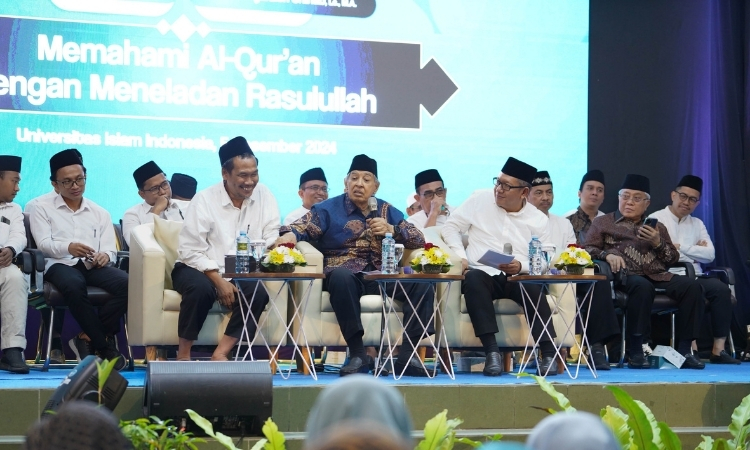
SLEMAN—Universitas Islam Indonesia (UII) once again held its “Ngaji Bareng” session with the theme “Understanding the Qur’an by Emulating the Prophet” at the Prof. K.H. Abdul Kahar Mudzakkir Auditorium of]n UII’s Main Campus on Thursday, December 5, 2024.
This event featured two distinguished Islamic scholars, Prof. Dr. M. Quraish Shihab, Lc., M.A., and K.H. Ahmad Bahauddin Nursalim, popularly known as Gus Baha.
Opening the event, UII Rector Fathul Wahid explained that unlike other religious gatherings, UII’s “Ngaji Bareng” sessions begin with the national anthem, “Indonesia Raya,” reflecting UII’s commitment to blending Islamic and national values.
Fathul Wahid emphasized that the session aimed to elevate attendees from being passive admirers (muhibbin) to active listeners (mustami’in) and even learners (muta’allimin).
“Let us, as admirers, continue to learn together. Hopefully, through this journey, we can elevate ourselves to the next level,” he expressed.
He also clarified the theme’s use of the term “meneladan” is conveying to emulate the Prophet, while with the additional ‘i’ as “meneladani” means to set an example, not to emulate.
“Here, we emulate the Prophet, not set an example for him. Through this understanding, we can better grasp the Qur’an,” he explained.
“Let’s align our intentions for this Ngaji Bareng so that the knowledge and understanding we gain will benefit not just us but also others,” he elaborated.
In his lecture, Prof. Quraish Shihab stressed the importance of understanding the Qur’an, as the Prophet Muhammad is a personification of its teachings. Referring to the Qur’an, Prof. Quraish introduced three key terms in the context of emulation: uswah, qudwah, and ittiba.
“The actions, traditions, and movements of the Prophet [peace be upon him] provide exemplary conduct. This is what we call uswah. Meanwhile, qudwah appears in the Qur’an when discussing previous prophets and instructing Prophet Muhammad,” explained the Director of the Center for Qur’anic Studies.
Further elaborating, Prof. Quraish noted that uswah refers to emulating the individual, while qudwah pertains to emulating the guidance or instructions rather than the person.
“The third term is ittiba. Ittabiu-tabiah differs from ittabia. Tabia means to follow, while ittaba’a involves a sincere and committed form of following. This commitment stems from a deep understanding of what Prophet Muhammad practiced,” he explained.
He also pointed out the need to distinguish the Prophet’s roles as a messenger and as a human being. “The Prophet’s companions largely recognized his roles as a messenger, a jurist [mufti], a judge [hakim], and as an individual,” he explained.
Furthermore, Prof. Quraish Shihab outlined four attributes to emulate the Prophet. First, siddiq, signifying sincerity in all aspects of life; second, amanah, meaning honesty and reliability in all responsibility.
“Third, fathanah, which involves cultivating spiritual, intellectual, and physical intelligence. And fourth, tabligh, which is conveying necessary messages and weighing the impact of every word and action,” he said.
“Ensure that what you say or write carries more benefits than harm,” he advised.
Meanwhile, Gus Baha emphasized the importance of ghirah (zeal and enthusiasm) in understanding the Qur’an.
“Ghirah is the most fundamental aspect of comprehending the Qur’an. Without it, understanding the Qur’an becomes impossible,” explained the caretaker of the Rembang-based Tahfizul Qur’an Islamic Boarding School.
