Future of Calligraphy in Digital Era
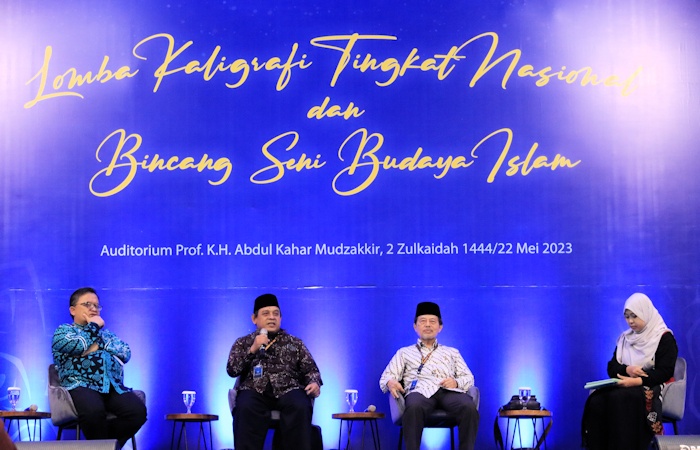
Yogyakarta—Universitas Islam Indonesia (UII) has organized an Islamic Art and Culture Talk titled “Challenges and the Future of Calligraphy in the Digital Technology Era”.
Taking place at UII’s Prof. K.H. Abdul Kahar Mudzakir Auditorium on Monday, 22 May 2023 and broadcast live via UII’s official YouTube channel, the talk was part of the celebrations of UII’s 80th anniversary.
The university organized a national calligraphy competition on the same day.
Attending as speakers for the talk were Ustaz Didin Sirojuddin (caretaker of Quranic Calligraphy Boarding School in Sukabumi), Dr. Ir. Revianto Budi Santoso, M.Arch. (Head of UII Architecture Study Program—Postgraduate Program), and Ustaz Robert Nasrullah (international artist and manager of the Center for Calligraphy Study of UIN Sunan Kalijaga).
Discussion moderator Stefy Prasasti Anggraini, S.T., M.Arch. said movements in the world of calligraphy was quite influenced by digitalization. The same impact was felt in other fields. This is especially since the current younger generation relies heavily on technology as well as the presence of impacts caused by developments in the current technological era that are related to artificial intelligence.
The first speaker, Ustaz Didin, said that calligraphy was termed as Islamic art. As one of the Islamic arts, calligraphy is often referred to as the art of Islamic art. “That means calligraphy has a higher position because the instructions come directly through the Quran,” he said.
According to him, the art of calligraphy has three attributes. First, calligraphy is a science that contains procedures and theories, and the understanding of whether writing letters are correct and perfectly sized. Second, calligraphy can be used as a beautification tool. Lastly, calligraphy contains its own philosophy.
Responding to the relationship between technological developments and the art of calligraphy, he said that current technology helped calligraphers’ performance. “In the past, mosque calligraphers had to manually design and calculate what they would write. But now, designs can be printed with just one or two machine presses,” he said.
Similarly, second speaker Ustaz Robert believes that digital technology does not pose a serious threat as calligraphers must be able to adapt to developments in digital technology to help create more attractive calligraphy.
“The digital industry is inevitable,” he said. “I truly appreciate UII for having adapted new technology for a long time. Their architectural results are also extraordinary.”
Ustaz Robert said that calligraphy contained two functions, namely peace and development of the human spirit. This concept will present new forms in visual calligraphy, he said.
Meanwhile, Dr. Revianto Budi Santoso said that the presence of technology should be embraced with extraordinary strategies, especially in the field of calligraphy. Digital technology is derived from algorithmic thinking by Al-Khwarizmi, a Muslim intellectual.
“We shouldn’t see calligraphy as an object, but rather as a condition that is greatly supported by technology,” he said.
In his view, technology has created the big challenge for calligraphers on how they can create completely new creations.
Therefore, technology has in fact facilitated the art of calligraphy. Everything that used to be made manually can now be made quickly, thanks to technology. (VIP Magazine Vol 10)

