
PUPR Ministry Holds Tree-Planting Event at UII’s Pelang Reservoir
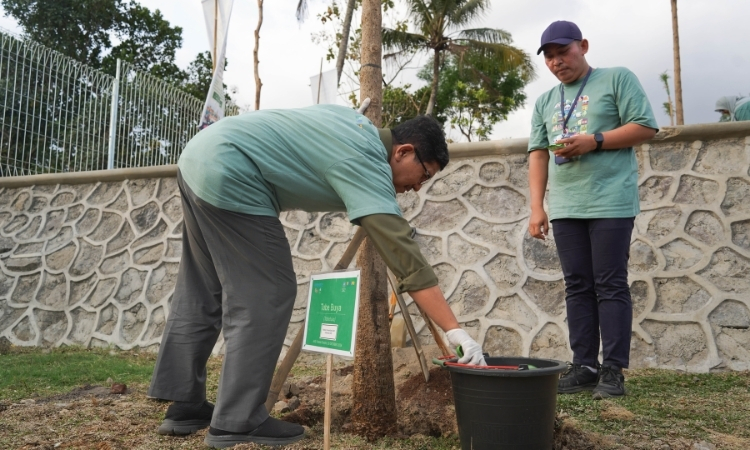
SLEMAN—The Directorate General of Human Settlements of The Ministry of Public Works and Housing’s (PUPR) held a tree-planting event in commemoration of the 2024 World Habitat Day–World Cities Day (WHD-WCD).
The event, held at the Pelang Reservoir/Universitas Islam Indonesia (UII) Reservoir on Thursday (10/10), involved various parties, including the PUPR Ministry, the Yogyakarta Regional Settlement Infrastructure Agency (BPPW), UII’s Waqf Foundation (YBW), and UII students.
In his report, Jonny Zainuri Echsan, S.T., MCM, Head of BPPW, noted that the Pelang Reservoir area had previously been an overgrown and unmanaged space, which was then transformed by the PUPR Ministry. He shared that 100 trees were planted in the Pelang Reservoir area.
“Today we will plant approximately 250 trees. Of these, 100 will be planted at UII, 100 at UGM, and 50 at Universitas Widya Mataram. The types of trees include mahogany, Trumpet trees, Crepe myrtle, and several other species that, Insya Allah [God willing], meet the recommended guidelines for both diameter and height,” said Jonny.
Ir. Dian Irawati, M.T., the Ministry’s Director of Housing and Settlement Engineering, gave a speech to open the event, stating that the tree planting was part of the WHD-WCD activities, aimed at reflecting on the current state of cities worldwide and the basic rights of residents to adequate housing.
“As the focal point for habitat issues in Indonesia, the PUPR Ministry plays an active role in addressing urban issues through programs and collaborations with relevant parties. The tree-planting at Pelang Reservoir is an effort to preserve the environment and enhance green open spaces through development initiatives by the Ministry. Planting trees can lower the local temperature, making it cooler and producing oxygen,” explained Dian Irawati.
UII Vice Rector for Resources and Career Development, Prof. Dr. Zaenal Arifin, M.Si., highlighted UII’s collaboration with the Ministry in greening the campus, emphasizing the importance of allowing students to learn in green open spaces.
“Learning should not only take place indoors but also involve exploring the campus. This area is one that students should visit to understand and appreciate the value of green spaces,” said Prof. Zaenal.

